
Teaching Awards, Certificates, and Funds
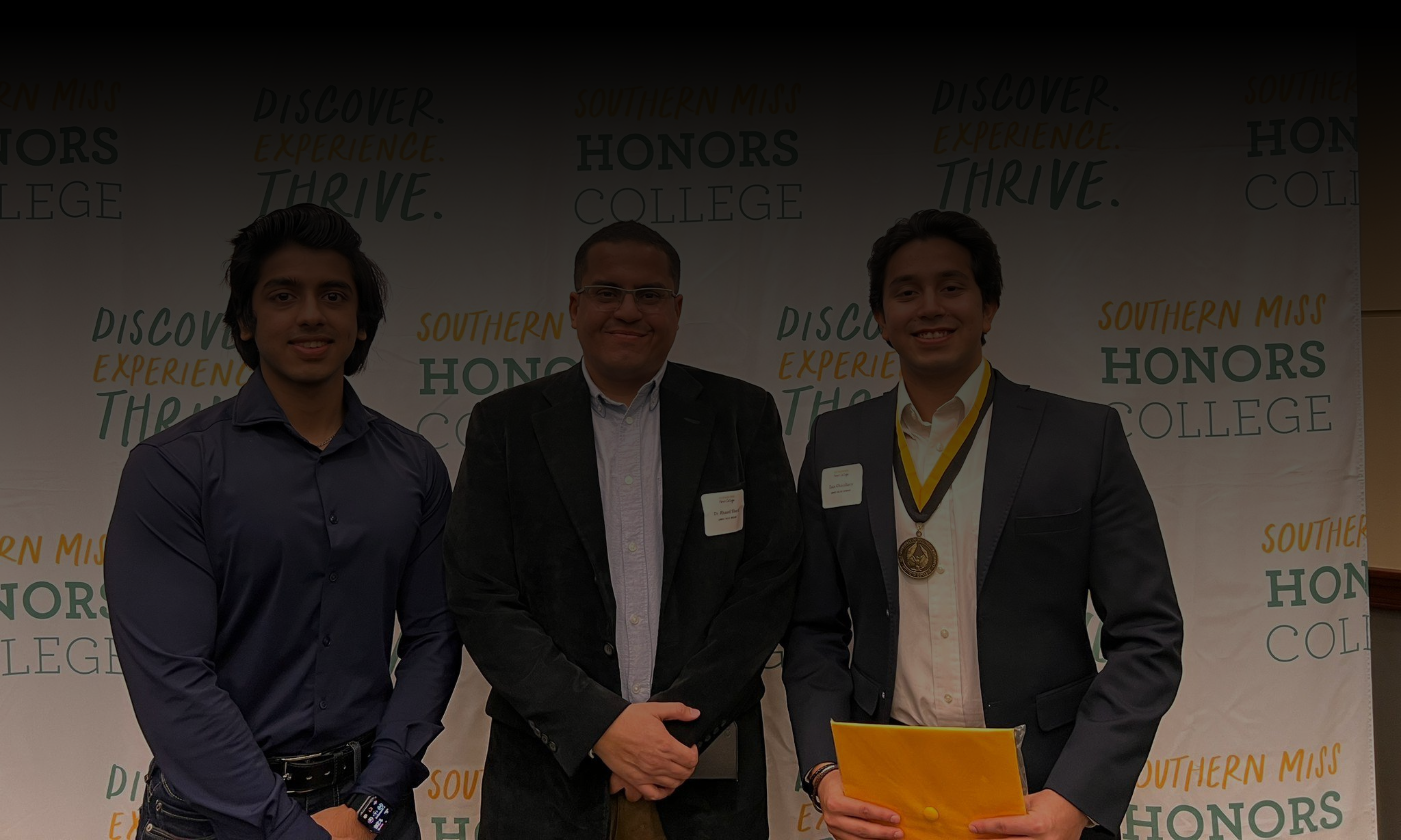
- University of Southern Mississippi 2021 Junior Faculty Outstanding Teaching Award
- ELEVATE 2025 Educational Grant Program, $50,000, Mississippi Board of Licensure for Professional Engineers & Surveyors
- Mentored three undergraduate students to win the 2025 ICPC Southeast USA Regional Programming Contest
- Completion of ACUE Promoting Active Learning
- Completion of ACUE Inspiring Inquiry and Preparing Lifelong Learners
- Ph.D. student Ujunwa Mbachu named to the USM Graduate Student Hall of Fame 2025
- UGS 2025 poster presentation by Samir Bhattarai and UGS 2025 paper presentation by Md Benozir Hossain
- DCUR grant funds, Dissertation Completion Grant, Graduate School Travel Award, and UGS 2024 poster presentations supporting SPEN students
Courses Taught at USM
Undergraduate Courses
CE 230 - Computer Systems
CE 260 - Computer Networks
CE 350 - Wireless and Network Security
CE 430 - Senior Design Project
CE 450 - Advanced Security and Privacy Techniques
CSC 206 - Introduction to Computer Organization and Systems
CSC 492 - Computer Science Problems I
CSC 492H - Computer Science Problems I
Graduate Courses
CSC 550 - Advanced Security and Privacy Techniques
CSC 650 - Applied Cryptography
COS 781 - Topics in Computational Sciences
COS 791 - Research in Computational Sciences
COS 898 - Dissertation
Courses Taught at Tennessee State University
Undergraduate
- ENGR-2000 - Circuits I
- ENGR-2001 - Circuits I Lab
- EECE-4300 - Digital Computer Structures
- ENGR-2230 - Engineering Programming
Graduate
- CISE-5020 - Computer Architecture and Operating System
- CISE-5230 - Computer Communications and Networks
- CISE-7350 - Network Security Risk Analysis
Teaching Innovation and Curriculum Development
New Courses
- CE 260: Computer Networks (2019 - Present)
- CE 350: Wireless and Network Security (2019 - Present)
- CE 450: Advanced Security and Privacy Techniques (2019 - Present)
- CSC 550: Advanced Security and Privacy Techniques (2023 - Present)
- CSC 650: Applied Cryptography (2024 - Present)
Major Course Revisions
- CE 430 - Senior Design Project (2020 - 2021)
- CE 230 - Computer Systems (2019 - 2024)
- CE 210 - Digital Logic (2018 - 2024)
Directed Student Learning
Dissertation Committee Chair
- Sajim Ahmed (Ph.D.), TBD (2026 - Present)
- Isaac Sarfo Larbi (Ph.D.), TBD (2026 - Present)
- Fahad Abdulrahman Alowayqil (Ph.D.), TBD (2026 - Present)
- Muhammad Zain Chaudhary (Ph.D.), Security and Privacy of Route Planning in Electrical Vehicles Charging (2025 - Present)
- Muhammad Zohaib Chaudhary (Ph.D.), Security and Privacy of Charging Coordination in Electrical Vehicles Charging (2025 - Present)
- Eduardo Antonio Hernandez Escobar (Master), Security and Privacy of the Internet of Drones (2023 - 2025, graduated and pursuing Ph.D.)
- Todd Kilbourne (Ph.D.), Towards Security and Privacy of Aviation Systems (2023 - Present)
- Razan Alsulieman (Ph.D.), AI-based Detection Systems of Drunk Drivers for Traffic Safety (2023 - Present)
- Richard Swilly (Master), AI-based Drunk Driver Detection (2023 - 2025, graduated)
- Ujunwa Madububa Mbachu (Ph.D., graduated), Secure and Privacy-Aware Traffic Control Applications (2022 - 2025)
- Partha Sengupta (Ph.D., graduated), Secure and Privacy-Preservation Application for Drones in Agriculture Monitoring (2022 - 2025)
- Muhammad Hataba (Ph.D., graduated), Software Protection Mechanisms for Autonomous Vehicular Cloud Computing (2019 - 2022)
Dissertation Committee Member
- Murad Hasan (Master), LLM-as-Judge for Reliable Crack Segmentation in Edge-Based Structural Inspection (2024 - 2026)
- Ticauris Stokes (Master), Analysis of Federated Image-Based Plant Disease Detection (2024 - 2026)
- Saswati Bhattacharjee (Master), Predicting Suicide Risk Among Youths Using Machine Learning Methods (2021 - 2023)
- Tom Henson (Master), Hardware Acceleration of KNN Encryption and Applications (2020 - 2022)
- Md Rana (Ph.D.), Android Malware and Deepfake Detection (2020 - 2022)
Undergraduate Honors Thesis
- Sarah Mirza, TBD (2026 - Present)
- Viktoriia Lavrentiv, TBD (2026 - Present)
- Samir Bhattarai, Hardware Implementation for IoD Security and Privacy (2025 - Present)
- Sajim Ahmed, Secure and AI-based E-health applications (2024 - Present)
- Md Benozir Hossain, AI-based Agricultural Monitoring Scheme (2024 - 2025, graduated)
- Tim Leonhardt, AI-based Intrusion Detection Methods for Smart Vehicles (2023 - 2025, graduated)
- Muhammad Zain, Secure and Privacy-Preservation Authentication Scheme for UAVs (2023 - 2024, graduated and joined the lab as a Ph.D. student)
- Latricia Terry, Security and Privacy of EV Charging (2023 - 2024)
- Alexander Haastrup, Secure and Privacy-aware Parking System for Autonomous Vehicles (Dec. 2020 - 2023, graduated)
- Peyton Whitten, Privacy-Preserving Data Aggregation for Smart Grids (Dec. 2020 - 2022)
- Kenechukwu Sibeudu, Privacy-Preserving Intelligent Traffic Control for Self-Driven Cars (2019 - 2021)